Q-Hall plates

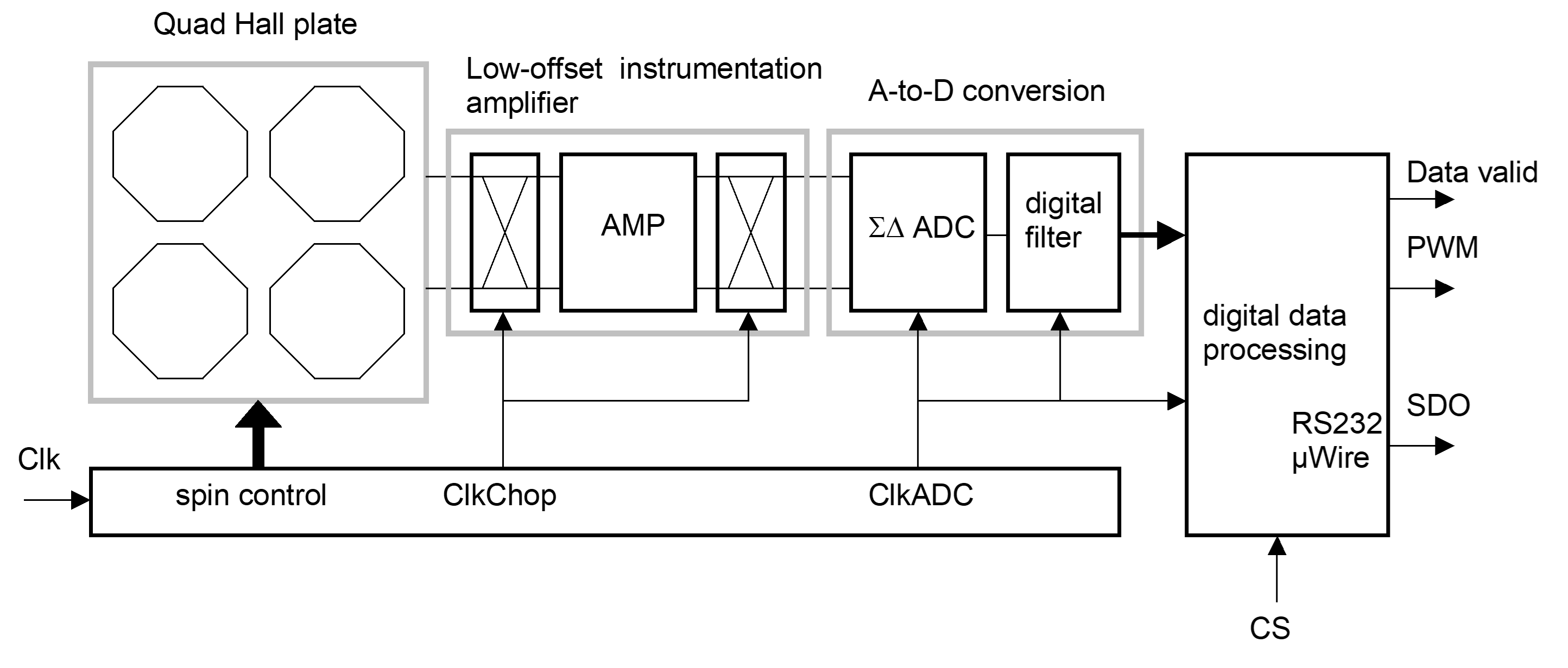
The Q-Hall technology was patented in 2003 and employs four Hall plates arranged in a quad configuration. The currents in each Hall plate are rotated in a predetermined manner to compensate for offsets caused by shear stresses, temperature gradients, and self-induced magnetic fields. These offset compensation techniques result in unparalleled accuracy for silicon Hall plates, with a production spread in offset of approximately one microtesla, and even greater stability.

Ultra precision electronics

A crucial element in the Hall ASIC is the use of ultra-precision electronics. It features an unprecedented two-stage low-offset, low-noise instrumentation amplifier combined with a 24-bit ultra-linear Sigma Delta converter.

No calibration needed

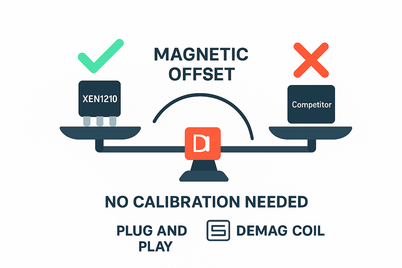
In contrast to other commercial solid state sensors, Sensix's products offer an exceptionally low offset without the need for on-the-fly spatial calibration routines or repolarizing magnetic-sensitive layers with build-in coils, as seen in all mobile phone compasses.

Ease of use

Our sensors can be daisy-chained and operated as a unified system. Many challenges in magnetic systems can be addressed by utilizing multiple measurement points to stabilize mechanical deviations, mitigate magnetic offset fields, and gather spatial information through sine and cosine measurements.

Q Hall technology

The Q-Hall technology was patented in 2003 and employs four Hall plates arranged in a quad configuration. The currents in each Hall plate are rotated in a predetermined manner to compensate for offsets caused by shear stresses, temperature gradients, and self-induced magnetic fields. These offset compensation techniques result in unparalleled accuracy for silicon Hall plates, with a production spread in offset of approximately one microtesla, and even greater stability.

Ultra precision electronics

A crucial element in the Hall ASIC is the use of ultra-precision electronics. It features an unprecedented two-stage low-offset, low-noise instrumentation amplifier combined with a 24-bit ultra-linear Sigma Delta converter.

Offset stability in Allan plot

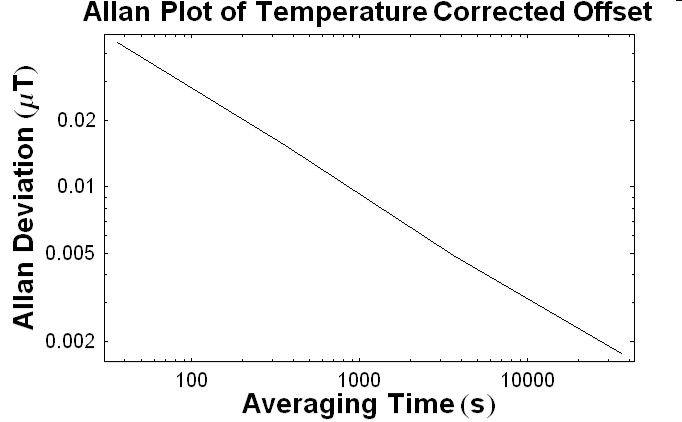
Measurement of the offset stability of the Q Hall configuration in combination with our electronics show a very good long term stability. In our Zero Gauss chamber offset measurement versus time are performed. Plotted in a so called Allan graph where the white noise per increasing averaged time window is displayed dont show a flattening of the down going slope. Which indicates that the 1/f noise point is not yet found on very long averaging periods. Since the temperature drift and expected field reduction of the Gauss chamber will exceed the shown levels there is little sense to go lower than nT levels. 
Temperature stability

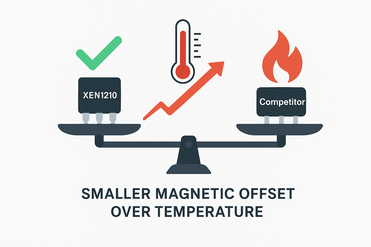
In comparison to commercial competition in standard ASIC compass solutions  Sensixs sensors also demonstrate unmatched resistance to offset temperature drift.

No calibration needed

In contrast to most of the world's compasses, Sensix's products offer an exceptionally low offset without the need for on-the-fly spatial calibration routines or repolarizing magnetic-sensitive layers with build-in coils, as seen in all mobile phone compasses.

Daisy chain

Our sensors can be daisy-chained and operated as a unified system. Many challenges in magnetic systems can be addressed by utilizing multiple measurement points to stabilize mechanical deviations, mitigate magnetic offset fields, and gather spatial information through sine and cosine measurements.

No external components

Our internal circuitry is designed to operate with a single supply, without the need for separate digital and analog supplies. Many of our customers do not even use decoupling capacitors.